
Georgia, A bridge between Asia and Europe
Connecting East and West
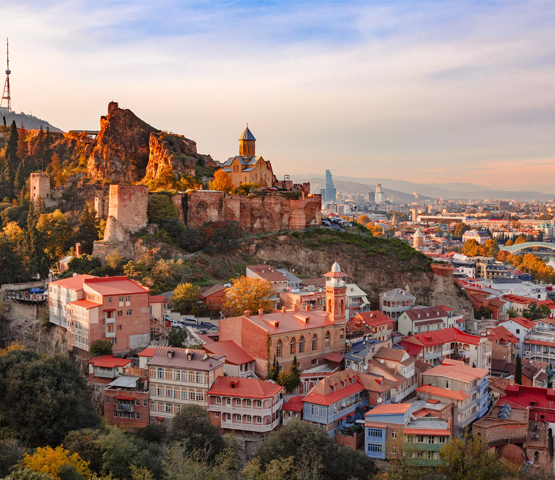
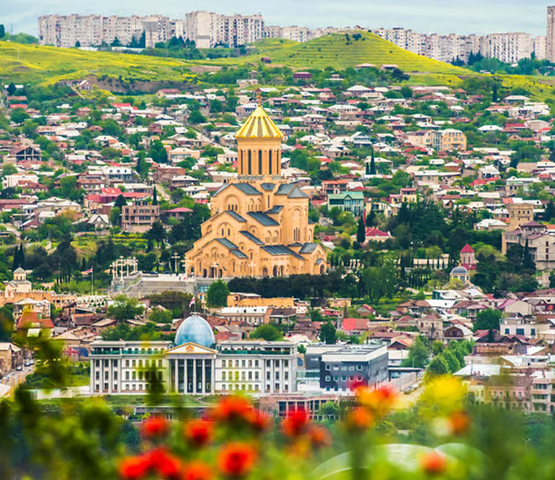
One of Europe’s oldest capitals, Tbilisi has been the cultural, political, and economic center of Georgia (Country) for fifteen centuries. At the heart of the city lies historic Old Tbilisi, which was built during the early Middle Ages. This two square kilometre section of the city is a must-see for any visitor to Tbilisi, as it houses some of the city’s most iconic sites.
The main attraction of Old Tbilisi is the colourful domed 17th-century baths. Fed by naturally hot sulfur water, legends say that it was these very waters that convinced King Vakhtang Gorgasali to found the city. As you soak in the very same waters and stare up at the decorative tiles of the domed baths, you’ll begin to understand why they might move a man to found an entire city in their name!
Tbilisi’s cosmopolitan nature is epitomized by the religious diversity that can be found within the city. As you wander the cobblestone streets and laneways of Old Tbilisi, you’ll see Georgian Orthodox churches, Armenian churches, Catholic churches, a mosque, and two synagogues.
Any Tbilisi bucket list is likely to feature a visit to the noble Metekhi Temple that sits high above the city on a cliff. A statue of the temple’s builder and the founder of Tbilisi, Vakhtang Gorgasali, stands in the temple courtyard. If you, like the king himself, look out from this courtyard, you’ll see the whole of Old Tbilisi sitting before you. It is one of the city’s most breathtaking views.
Georgia's economy is a developing free-market system showing strong recent growth, driven by reforms, tourism, transit trade, and a favorable business environment, with key sectors including services, agriculture, and manufacturing, though challenges like productivity remain, as it leverages its strategic location between Europe and Asia.
Key Characteristics:
Emerging Market: Transitioned from a post-Soviet state to a more functional market economy through significant reforms.
Rapid Growth: Experienced high GDP growth rates in recent years, with forecasts suggesting continued expansion.
Reached over $33 billion in 2024, with strong growth rates (e.g., 7-9% annually since 2021).
Strategic Location: Acts as a vital transport and trade corridor connecting Europe and Asia.
Reforms: Known for streamlining bureaucracy, ranking well in ease of doing business, and attracting investment
Sights in Tbilisi
Turtle Lake
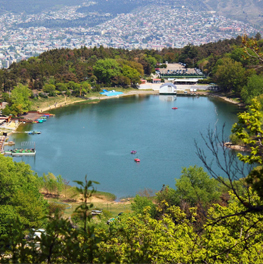
Turtle Lake - or Kork Lake - is a lake in Georgia, in the city of Tbilisi. It is located southwest of the city center, on the northern slope of the Mtatsminda ridge, at an altitude of 686.7 m above sea level. Surface area 0.034 km, basin area 0.4 km, maximum depth 2.6 m, average depth 1.7 m. The length of the lake is 180 m and the width is 50 m. Placed in a small pan, it was formed by exotectonics - mainly as a result of landslide rocks.
Vake Park
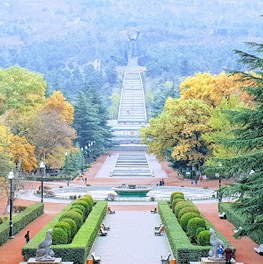
Vake Park (Georgian: ვაკის პარკი) is a public park in Tbilisi. The park was opened in 1946 and is located in the Vake district of Tbilisi at the western end of Chavchavadze Avenue. A World War II memorial sits at the top of the hill in the park.
Narikala Fortress
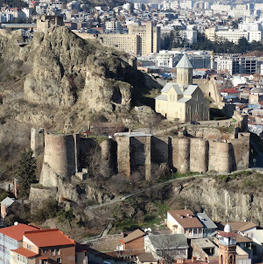
Narikala (Georgian: ნარიყალა, pronounced [naɾiχʼaɫa]) is an ancient fortress overlooking Tbilisi, the capital of Georgia, and the Mtkvari (Kura) River. The fortress consists of two walled sections on a steep hill between the sulfur baths and the botanical gardens of Tbilisi. On the lower court there is the recently restored St Nicholas church. Newly built in 1996–1997, it replaces the original 13th-century church that was destroyed in a fire. The new church is of "prescribed cross" type, having doors on three sides. The internal part of the church is decorated with the frescos showing scenes from both the Bible and the history of Georgia.
Art Palace
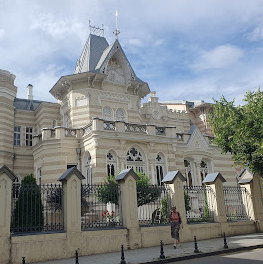
Art Palace of Georgia - Museum of Cultural History also referred to as Art Palace, (Georgian: საქართველოს ხელოვნების სასახლე – კულტურის ისტორიის მუზეუმი) is located in Tbilisi, Georgia. It is located on Kargareteli Street #6, and was the former Graph Oldenburg's Palace. The museum's exhibition halls are open from Tuesday till Sunday (10:30 - 17:30)